- A tip needs a name, a distance and one reason, or the guest will search for it anyway.
- Eight to twelve places you have actually been to beat a list copied from a search engine.
- Check the list at the start of each season and delete what has closed, because one dead tip costs you the trust in the rest.
It is 18:30 on the first evening. The guests have unpacked, found the Wi-Fi and are standing in the kitchen with the same question: where do we eat? They open a search engine, get hundreds of results, and pick whatever has the most stars. You never hear about it, except that the place they chose was shut on Mondays and the walk took forty minutes.
You know a better answer. The trouble is getting it from your head onto a page in a form that someone hungry and slightly tired will actually use.
Why “there are many nice restaurants” is useless
Most local sections fail in the same way. They say things like:
- “The town has many lovely restaurants.”
- “Don’t miss the old town!”
- “Great beaches nearby.”
None of these tells a guest anything they could not learn from the name of the town. They are not wrong, just empty. A guest cannot act on them, so they go to a search engine, and then your section has done nothing.
Guests can find the popular places on their own. What they cannot find is the bakery you queue at on Saturday, the beach that is empty before ten, or the restaurant that locals book and tourists walk past. That gap is the only reason to write a local section at all.
The shape of a good tip
Every tip needs three things:
- A name a guest can type or tap, exactly as it appears on the door.
- A distance, in the unit the guest will use: minutes on foot, or minutes by car.
- One reason, written as you would say it to a friend.
Compare these two:
- “Restaurant Marta, Italian.”
- “Marta, 6 minutes on foot. Small place, the fresh pasta is the only thing worth ordering, and you need to book on Fridays.”
The second one answers the three questions a guest has: can I get there, what do I order, and do I need a plan. The first one just sends them back to a search engine to find out.
The distance matters more than hosts expect. A guest with a car and a toddler reads “20 minutes away” as a decision. “Nearby” is not a distance, and a guest cannot plan a day around it.
How many is too many
Fewer than you think. Eight to twelve places is plenty for a typical apartment or house, spread over a few types:
- Eating: a breakfast place, an easy dinner, one for a special evening
- The sea, the lake or the park: the one you would actually go to
- Things to do: one for a rainy day, one for children if your guests often bring them
- Practical: the nearest supermarket and what time it closes, a pharmacy, a place that sells bread on Sunday
The practical items are the most used and the least written. Guests arriving late on a Sunday do not want the best restaurant in town. They want to know where to buy milk.
If you have more than twelve, you are probably listing places to prove you know the area. Cut the ones you would not send your own family to.
Write for the first evening and the rainy day
Two moments produce most of the searches. The first is the arrival evening, when guests are tired and hungry and want something close, easy and open. The second is the day the weather turns, when the plan for the beach falls apart.
Check your list against both. If a guest arriving at seven on a Sunday finds three places that are shut, the section has failed at the moment it was most needed. Put the opening days and hours in the tip when they are unusual, and leave them out when the place is simply open every day.
What to leave out
- Places you have not been to. If you cannot say why, the tip is just a listing.
- Chains and anything a guest will find on the first page of results. Include them only when they are practical, like a supermarket.
- Prices. They go out of date faster than anything else on the page. Say “cheap”, “mid” or “special occasion” if you must.
- Long descriptions. Two sentences. A guest is reading on a phone, standing up.
- Commission you do not mention. If you earn from a booking, say so in a line.
Keep it alive
A local section ages quietly. Restaurants close, a beach gets a new car park fee, the market moves to Thursdays. One wrong tip is enough for a guest to stop trusting the rest of the page.
Set a reminder at the start of each season to read your own list as a guest would. Walk past the two or three places you are least sure of. Delete anything you would not send a friend to today. It takes twenty minutes and it is the cheapest quality check you have.
Guests also tell you what is missing. If three guests in a row ask where to rent bikes, the answer belongs on the page. Your message history is a better outline than anything you plan from scratch, the same way it is for the rest of an Airbnb welcome book.
Paper or phone for local tips
Paper has a real advantage here: a printed map on the fridge with a few circles on it is quick, and it works with no signal at all. For a single apartment with five tips that never change, it may be all you need.
A phone wins when the list is longer than a map can hold, when it changes, and when the guest wants to tap an address and be walked there. It also lets you fix a wrong tip once and have every guest see the correction, including those who booked months ago. If you are weighing the two for the whole guest information, the comparison of a printed welcome book or a digital guide goes through it.
Where this fits in GuestPorta
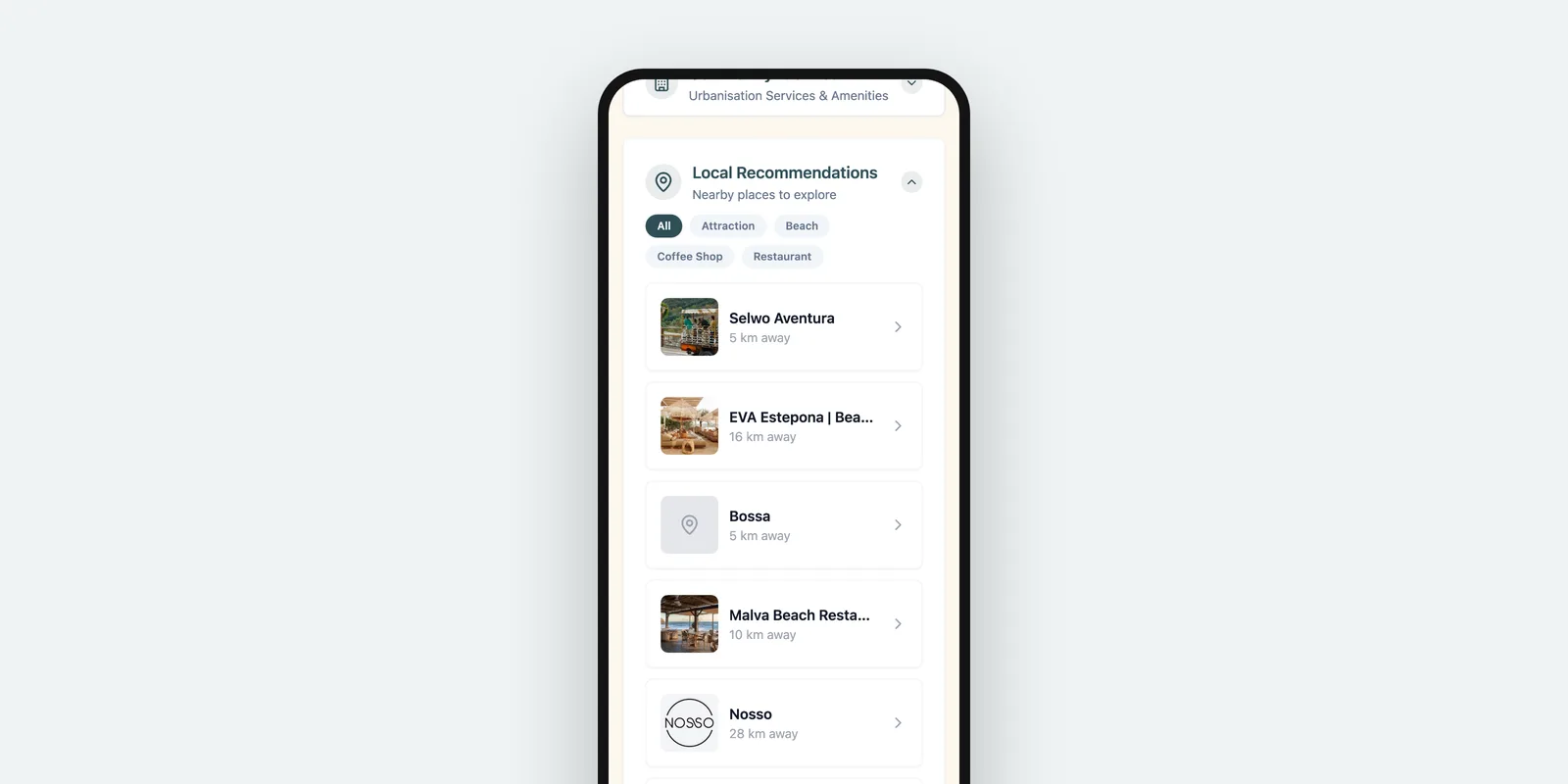
On a GuestPorta page, local tips are a section of their own. Each place shows its distance from the property, and guests can filter by type, for example to see only the beaches or only the cafés. You add or change a tip yourself, and the change shows for every guest straight away.
It does not write the tips for you. The useful part, the reason you would send someone there, is yours. If you run a holiday home and your guests arrive from abroad, the holiday homes page shows how the local section sits next to arrival, Wi-Fi and the house rules.
FAQ
How many local recommendations should I give guests?
Between eight and twelve is enough for most properties, split over a few types such as food, beaches and things to do. Guests on a short stay will try two or three of them. A longer list only makes them open a search engine instead.
Should I include places I have not been to myself?
No. A recommendation is only worth something because you stand behind it. If a guest asks about a place you have not tried, say so in your reply and leave it off the page.
Is it fine to recommend places that pay me a commission?
If you are paid, say so on the page in one line. Guests forgive a commission much more easily than they forgive finding out later, and an honest tip with a disclosure still gets used.
The GuestPorta team builds digital guest pages for hosts and property managers, and writes about guest communication for short-term rentals.